
High-Quality Vertical Storing Dock Leveler Solutions
Think about what happens to a standard dock leveler when no truck is parked at the bay. The pit sits there, recessed into the floor, catching rain, dust, the occasional stray cat, and letting cold air seep straight out through the gap the dock door can’t fully close over.
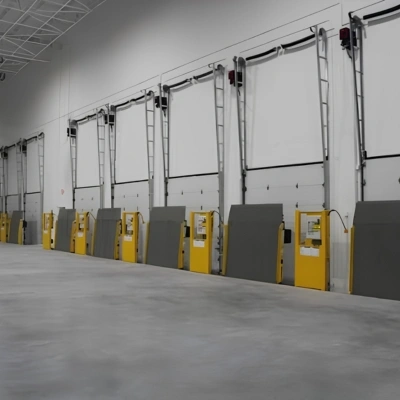
It’s a problem most warehouse operators just live with — until they don’t have to. A Vertical Storing Dock Leveler solves it by doing something different: when it’s not in use, the whole platform folds up and stores vertically inside the door frame, letting the dock door shut completely flush against the floor.
No open pit sitting exposed. No draft eating into your cold storage temperatures overnight. When a truck arrives, the platform lowers back down, the lip extends, and it works exactly like any other hydraulic leveler — the difference only shows up in what happens when nobody’s loading.
Key Features

Stores upright inside the door frame when idle, allowing full door closure at floor level
Pit stays sealed, dry, and free of debris between loads

Hydraulic push-button operation for raising, lowering, and storing the platform
Extending lip that reaches the truck bed once lowered into working position

Doubles as a physical barrier across the doorway when stored — nothing rolls out into an empty bay by accident
Anti-skid deck surface for secure footing during active use
Overload protection and emergency stop included as standard safety features
Applications
This style of leveler earns its cost back fastest in cold storage warehouses, where every open pit is a direct hit to refrigeration efficiency — conditioned air escaping, outside heat creeping in, compressors working overtime to compensate. Sealing that gap when the dock isn’t active makes a measurable difference over a full year of operation, not just a marginal one.
Pharma and food-grade facilities benefit for a related but slightly different reason: hygiene. An open pit is an entry point for dust, pests, and contamination, which matters a lot more in a regulated environment than in a general warehouse.
Facilities in regions with heavy monsoon rainfall have their own version of this problem too — an exposed pit during a downpour means standing water, and standing water in a dock pit is never a good sign.
There’s also a safety angle that gets overlooked. When the platform is stored vertically, it physically blocks the doorway opening, which means a forklift operator can’t accidentally drive off an open edge when no trailer happens to be parked there.
For high-traffic bays where doors open and close constantly throughout a shift, that barrier function alone justifies the format for a lot of safety-conscious facilities.

Why Choose Us
- Built entirely in-house, so the folding mechanism and hydraulics are tested as one integrated system, not bolted together from mismatched parts
- Particularly suited to facilities where sealing the pit actually matters, not just a nice-to-have
- Engineered for repeated raise-lower-store cycles without the mechanism binding up over time
- Cuts down on energy loss that comes from an open, unsealed dock pit
- Custom-fitted to your existing door frame and pit dimensions
- A team that stays available for servicing questions long after installation
Frequently Asked Questions
What does "vertical storing" mean for this type of leveler?
When not in use, the platform folds upward and stores inside the door frame instead of lying flat in an open pit, allowing the dock door to close completely against the floor.
Does this leave the pit exposed like a standard dock leveler does?
No — that’s the main advantage. The pit stays sealed and protected whenever the leveler isn’t actively in use.
Is this a good fit for cold storage facilities?
Yes, it’s one of the primary reasons operators choose this format — sealing the pit reduces cold air loss and helps maintain consistent internal temperatures.
Is a vertical storing leveler harder to maintain than a standard hydraulic one?
Not significantly. It’s still a hydraulic system at its core, just with an added folding and storing mechanism, so maintenance follows a similar routine.