
High-Quality Retractable Dock Shelter Solutions
Watch enough trucks back into a busy loading bay and you’ll notice something: almost nobody does it perfectly, every single time. A trailer clips a corner, backs in at a slight angle, or catches the frame edge while adjusting position. On a shelter with a rigid frame, that’s exactly how cracks start — a hairline fracture this month, a genuinely bent frame member by next year.
A Retractable Dock Shelter is built around that reality instead of ignoring it. The frame itself is mounted on a spring-loaded or hinged mechanism that gives way under impact, absorbs the force, and springs back into position once the pressure’s gone.
It’s a small structural difference that changes the entire maintenance conversation. Instead of budgeting for frame repairs every time a driver misjudges an approach, the shelter simply flexes, resets, and keeps working.
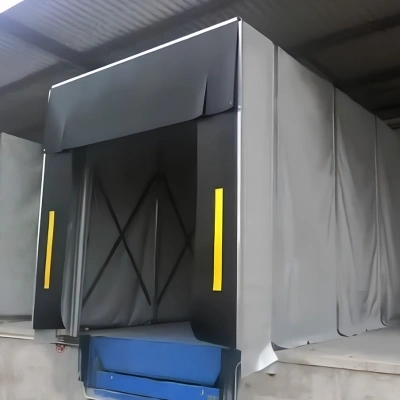
Key Features
Spring-loaded or hinged frame mechanism engineered to yield on impact rather than crack or bend permanently

Automatic return to original position once impact pressure is released — no manual resetting required

Galvanized steel frame components built for repeated flex cycles over years of use, not a one-time impact tolerance
Flexible curtain material paired with the retractable frame, wrapping around varying vehicle widths and heights
Reduces structural stress transferred to the building wall mount during off-center dockings
Wall-mounted installation compatible with standard dock door openings
Works alongside existing dock levelers, bumpers, and lighting already installed at the bay
Applications
The Retractable Frame earns its keep hardest at facilities where driving conditions aren’t ideal, and that’s a longer list than people expect. Multi-carrier logistics hubs and 3PL warehouses see a constant rotation of different drivers, many of whom have never backed into that specific bay before — no familiarity with the yard, no muscle memory for the approach angle, which naturally means more contact with the shelter frame over time.
Facilities in tight urban yards with limited maneuvering space run into the same issue, just for a different reason: there simply isn’t enough room for every truck to line up cleanly.
High-volume distribution centers running trucks through a bay dozens of times a day compound the risk simply through repetition — even a low percentage of imperfect dockings adds up fast at that kind of frequency.
And any facility that’s already replaced a rigid-frame shelter once or twice due to impact damage is a strong candidate for switching to a retractable frame the next time around, since the underlying problem (drivers occasionally misjudging the approach) isn’t going away on its own.
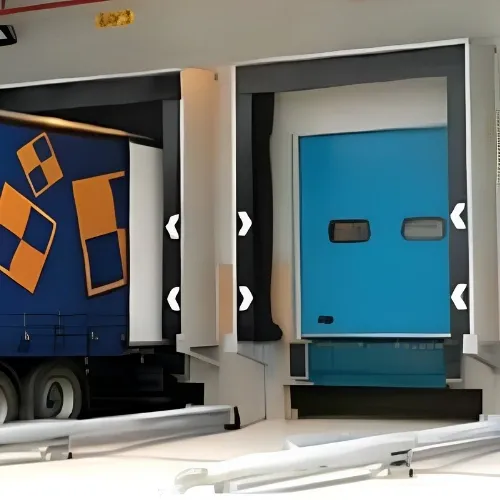
Facilities with a small, consistent set of experienced drivers backing into the same bay daily see less benefit here — a rigid frame might genuinely be sufficient in that narrower scenario. But wherever driver variability or tight maneuvering is part of daily reality, the Retractable Frame pays for its higher upfront cost through everything it doesn’t need repaired later.
Why Choose Us
- Frame mechanism engineered and tested for repeated impact cycles, not just a single worst-case scenario
- Manufactured in-house, so the spring tension and return mechanism are calibrated as one system, not assembled from mismatched third-party parts
- Genuinely reduces long-term repair costs compared to rigid-frame shelters at high-traffic bays
- Built to protect the building structure itself, not just the shelter — less force transfers back to the wall mount on impact
- Fitted to your exact dock opening rather than sold as a generic universal size
- A team that stays reachable for any frame or tension adjustments needed after installation
Frequently Asked Questions
How is a retractable dock shelter different from a standard dock shelter?
The frame itself is engineered to flex and absorb impact through a spring-loaded or hinged mechanism, then return to position automatically — a standard rigid frame doesn’t have that give, so it’s more prone to cracking or bending from off-center impacts.
Does the frame need to be manually reset after an impact?
No — the return mechanism is automatic. Once the pressure from the impact releases, the frame springs back into its original position on its own.
Is a retractable frame worth the extra cost for a low-traffic dock?
Not necessarily. Facilities with consistent, experienced drivers and light traffic may do fine with a standard rigid-frame shelter. The retractable design earns its value most at high-traffic or multi-driver sites.
Does the retractable mechanism affect how well the shelter seals against the vehicle?
No — the curtain material and sealing performance work the same way as a standard shelter. The retractable element is specifically about protecting the frame structure, not the seal itself.