
High-Quality Dock Seal Solutions
Strip away the curtains, the air cushions, and the spring-loaded frame, and you’re left with the most basic version of the same problem: how do you close the gap around a truck without any moving parts at all? A Dock Seal answers that with foam.
Dense, compression-molded foam pads — one across the top, one down each side — mounted directly onto the building face. When a truck backs in and the driver pulls forward against it, the pads compress and press flush against the vehicle’s body, forming a solid physical barrier with nothing to inflate, retract, or motorize.
It’s the oldest, most straightforward approach to dock sealing, and it still gets specified constantly for one simple reason: fleets that run the same truck model, or a narrow range of similar ones, don’t need anything more complicated than this. Why pay for adaptability you’ll never use?

Key Features

Compression-molded foam core pads — one head pad, two side pads — covered in heavy-duty, abrasion-resistant fabric
Seals purely through compression contact as the vehicle pulls in against the pads
Zero moving parts, motors, or inflation systems — nothing to power, nothing to cycle
Fabric covering built to withstand repeated direct contact without tearing or wearing thin

Steel back-frame mounting for secure, permanent attachment to the building face
Sized to match your typical fleet’s vehicle dimensions for a consistent, snug fit
Lowest-maintenance option among all our dock sealing products, by a fair margin
Applications
A Dock Seal earns its place specifically where fleet consistency is already a given. Distribution centers running their own company-owned trucks are the clearest example — if the same handful of vehicle models show up at that bay every single day, a seal fitted to those exact dimensions works about as well as any sealing method can.
Retail and grocery chains with dedicated delivery fleets fall into the same category, since their trucks are typically standardized across the whole operation rather than varying supplier to supplier.
Contracted logistics arrangements where a facility works with one or two regular carriers also do well with seals, particularly once there’s enough history to know exactly what shows up at the dock.
And because a Dock Seal is designed around constant physical contact rather than trying to avoid it, high-frequency bays with the same vehicle type cycling through dozens of times a day actually suit a seal better than they’d suit a shelter — this is a product built for contact, not one that has to absorb it as an occasional accident.
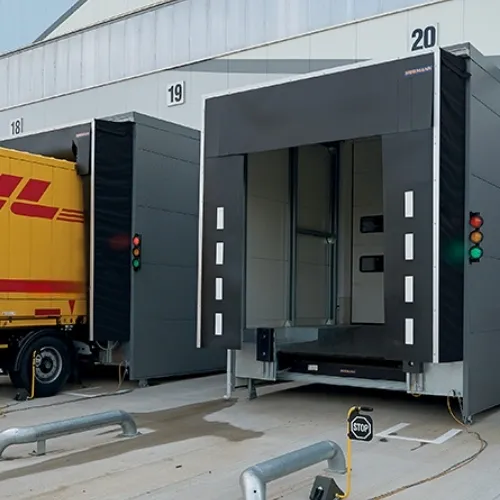
Where it doesn’t make as much sense is anywhere fleet composition varies a lot — third-party logistics hubs serving different carriers, or docks that see everything from small vans to full trailers. A seal sized for one vehicle type won’t compress properly against a very different one, leaving gaps exactly where you don’t want them. In that situation, a flexible curtain shelter or an inflatable system will genuinely serve you better, even at a higher upfront cost.
Why Choose Us
- Foam density and fabric grade selected specifically for daily, repeated compression — not a soft pad that flattens out after a few months
- Built and fitted in-house, so the pad dimensions and mounting frame are matched precisely to each other
- Straightforward installation without any wiring, blower units, or moving mechanisms to configure
- Genuinely the lowest long-term maintenance of our sealing range, since there's nothing mechanical to service or replace
- We'll tell you honestly if your fleet has too much size variation for a seal to make sense — better that than selling you the wrong product
- Replacement pads and fitting support available whenever wear eventually calls for it
Frequently Asked Questions
How does an inflatable dock shelter create a tighter seal than a standard one?
The air cushions expand and conform to the actual shape of each vehicle once inflated, closing irregular gaps that a fixed curtain shape might leave against non-standard truck bodies.
Does an inflatable dock shelter need a power connection?
Yes — a motorized blower handles the inflate and deflate cycle, which is the tradeoff for the tighter seal compared to a fully passive curtain shelter.
Is this necessary for a standard warehouse, or only specific industries?
General warehousing usually does fine with a standard curtain shelter. Inflatable systems earn their cost specifically in cold storage, pharma, and food distribution, where seal tightness has a direct, measurable impact.
How durable is the inflatable bladder material?
It’s built from reinforced, puncture-resistant fabric designed specifically for repeated daily inflate-deflate cycling, not a lightweight material that degrades after a season.