
High-Quality Mobile Dock Ramp Solutions
A lot of loading problems aren’t really about equipment — they’re about equipment being stuck in the wrong place. Maybe you’ve got three bays and trucks arriving faster than one fixed ramp can handle. Maybe today’s delivery point isn’t where yesterday’s was.
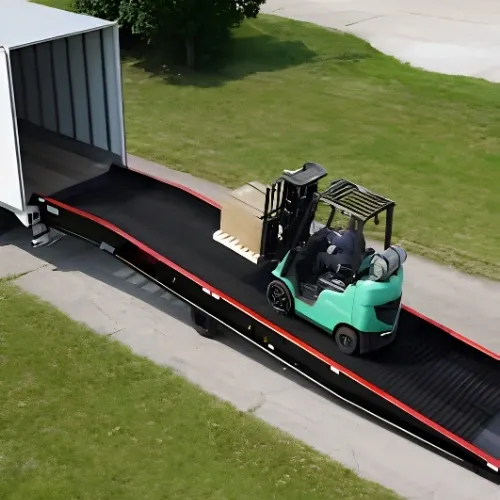
A Mobile Dock Ramp solves that specific headache by being exactly what it sounds like: a heavy-duty loading ramp that goes wherever the truck actually is, instead of the other way around.
Wheeled and fully portable, it gets rolled into position, adjusted to match the vehicle’s bed height, and put to work — no bolts, no fixed installation point, nothing tying it to a single spot on your floor. When the next truck shows up somewhere else entirely, the ramp goes with it.

Key Features

Fully portable, wheeled design built for quick repositioning across a facility
Height adjustment to match varying truck and container bed levels on the fly
Manufactured in multiple capacity ranges — from lighter-duty operations up to genuinely heavy industrial loads, fully customizable
Heavy-duty chequered steel platform with an anti-skid surface finish

Reinforced steel frame designed to take repeated relocation without loosening or flexing
Heavy-duty front lip for a smooth, stable transition onto the vehicle bed
Safety side curbs and a chain locking system to secure the ramp against the truck during loading
Available in manual or hydraulic-assisted adjustment, depending on how often it’s being repositioned
Applications
Mobile Dock Ramps solve a specific kind of operational problem, and it shows up more often than people expect. Facilities with multiple loading bays but only one or two ramps worth owning benefit immediately — rather than fixed equipment sitting idle at an empty bay while another bay has three trucks waiting, one mobile ramp serves wherever it’s actually needed that hour.
Warehouses and logistics operations dealing with seasonal or fluctuating volume find real value here too. Ramping up for a peak season rush doesn’t require a construction project — it just means having a mobile unit ready to deploy at whichever loading point gets busy.
Sites still finalizing their permanent dock layout, or businesses testing a new location before committing to fixed infrastructure, use Mobile Dock Ramps as a practical stopgap that still performs like proper industrial equipment.
There’s also the backup-equipment angle. When a fixed leveler goes down for maintenance or repair, a mobile ramp keeps that bay operational in the meantime — trucks don’t just sit outside waiting for a technician to finish a repair.
For facilities where any loading downtime translates directly into cost, having that kind of flexibility on hand isn’t a luxury, it’s just good planning.
Why Choose Us
- Built in-house from heavy-duty steel, not a lightweight import that flexes under real industrial load
- Designed specifically to survive constant relocation — wheels, frame, and joints all engineered for that use pattern, not just single-spot installation
- Safety features like curbs and locking chains included as standard, not optional extras
- Multiple capacity options, so you're not overpaying for tonnage you'll never actually need
- Quicker to deploy than any fixed installation, with zero construction downtime
- A team that helps you figure out the right capacity and adjustment type for your actual operation, not just whatever's in stock
Frequently Asked Questions
How is a mobile dock ramp different from a fixed one?
A mobile ramp is wheeled and fully repositionable, moved wherever loading is needed. A fixed ramp is permanently installed at one location and doesn’t move.
Can one mobile ramp serve multiple loading bays?
Yes — that’s one of its main advantages. It gets wheeled to whichever bay needs it rather than sitting fixed at a single point.
What load capacities are available?
We manufacture across a range of capacities to suit both lighter operations and heavier industrial loads, customized to your actual requirements.
Does the ramp adjust to different vehicle heights?
Yes, height adjustment is built in specifically to accommodate the varying bed heights of different trucks and containers.