
High-Quality Inflatable Dock Shelter Solutions
A fixed curtain does a decent job wrapping around a truck, but “decent” isn’t always good enough. Refrigerated trailers, container trucks, and vehicles with irregular body shapes — mirrors sticking out, uneven panel lines, non-standard widths — don’t always sit flush against a fixed fabric curtain, and every gap that’s left is a gap for cold air, dust, or contamination to slip through.
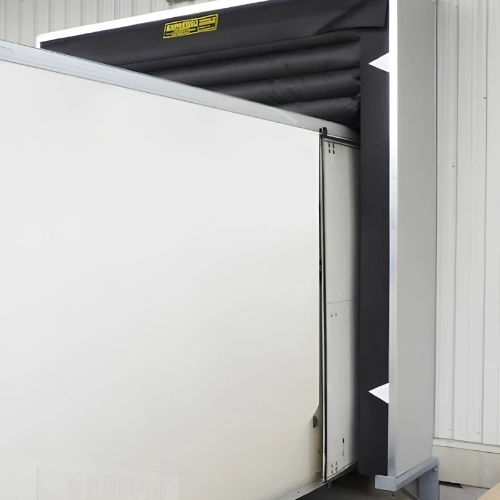
An Inflatable Dock Shelter solves that differently: instead of a static curtain, air cushions along the top and both sides inflate once the truck backs into position, expanding to conform to whatever shape actually shows up at your dock.
The result is a seal that’s noticeably tighter than a fixed-curtain setup, simply because the cushions adjust to the vehicle rather than the vehicle needing to match a predetermined shape.
Once loading’s done, the cushions deflate automatically, the truck pulls away clean, and the whole cycle resets for the next vehicle.

Key Features
Inflatable air cushions on the top and both sides, expanding to conform tightly around the actual shape of each vehicle
Motorized blower system that inflates and deflates the cushions automatically, typically triggered on door operation or a simple control button
Reinforced, puncture-resistant fabric bladder built to handle repeated daily inflate-deflate cycles without tearing

Steel support frame anchoring the system securely to the building face
Noticeably tighter seal than fixed-curtain shelters, especially against irregular or non-standard vehicle bodies
Automatic deflation on cycle completion, so there’s no manual reset step between trucks
Compatible with existing dock levelers and bumpers already installed at the bay
Applications
Inflatable Dock Shelters earn their cost specifically where air leakage has a real, measurable consequence. Cold storage and frozen goods facilities are the clearest case — every gap around an imperfectly sealed truck means conditioned air escaping and warmer air creeping in, and over a full year, that translates directly into higher energy costs and compressors working harder than they should have to.
Blast freezer operations feel this even more acutely, given how much colder the internal environment runs compared to outside temperatures.
Pharma and biotech facilities lean on Inflatable Dock Shelters for a related but distinct reason: contamination control. When a facility’s audits or GMP compliance depend on demonstrating a controlled environment, a seal that visibly conforms tightly around the vehicle is a stronger answer than a curtain that might leave a gap near an oddly shaped trailer.
Food distribution centers handling temperature-sensitive goods sit in similar territory, where product quality depends on minimizing temperature swings during every single loading cycle, not just most of them.
Facilities running a genuinely mixed fleet — different truck models, different trailer shapes, container trucks alongside standard delivery vehicles — also benefit, since a fixed curtain calibrated for one vehicle type often underperforms against another. An inflatable system adjusts on the fly, regardless of what backs in.
For general warehousing without those specific pressures, a standard curtain-type dock shelter usually covers the need at a lower cost — inflatable systems make the most sense when air-tightness is a measurable requirement, not just a general preference.
Why Choose Us
- Reinforced fabric bladders manufactured in-house and built specifically for repeated inflate-deflate cycling, not a thin material that wears through in months
- Engineered for facilities where seal tightness genuinely affects product integrity or compliance, not just general weatherproofing
- Automatic inflation cycle reduces dependency on operators remembering to manually adjust anything
- Steel anchoring frame sized to your exact dock opening
- Support available well beyond installation, for any servicing the blower system might need down the line
- A team that helps you weigh this against a standard curtain shelter honestly, rather than upselling it where it isn't needed
Frequently Asked Questions
How does an inflatable dock shelter create a tighter seal than a standard one?
The air cushions expand and conform to the actual shape of each vehicle once inflated, closing irregular gaps that a fixed curtain shape might leave against non-standard truck bodies.
Does an inflatable dock shelter need a power connection?
Yes — a motorized blower handles the inflate and deflate cycle, which is the tradeoff for the tighter seal compared to a fully passive curtain shelter.
Is this necessary for a standard warehouse, or only specific industries?
General warehousing usually does fine with a standard curtain shelter. Inflatable systems earn their cost specifically in cold storage, pharma, and food distribution, where seal tightness has a direct, measurable impact.
What is the durability of the inflatable bladder material?
It is constructed with reinforced, puncture resistant fabric that is meant to withstand high-cycling of inflation and deflation on a daily basis, and is not intended to be flimsy that it only lasts a year.